Multi-Column Answer Support in Iris Projects
Last updated: May 18, 2026
Overview
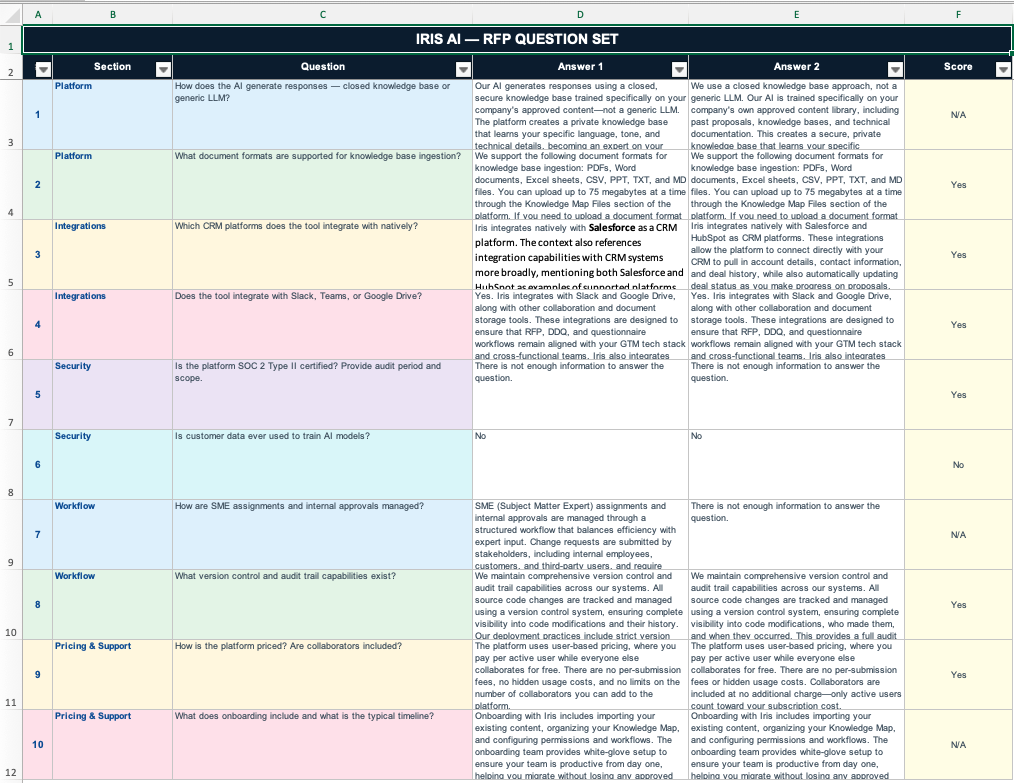
Many security questionnaires, RFPs, and compliance documents contain questions that require more than one answer — for example, a spreadsheet with separate columns for "Vendor Answers," "Additional Information," "Guidance," and "Analyst Notes" all tied to the same question row. This article covers how Iris handles multiple answers for a single question — including text answers, dropdowns, and mixed combinations — all from within the same project workspace.
What's New
Multiple answer columns per question — Iris generates responses for every annotated column in your spreadsheet, not just one.
New "Header" annotation type — A dedicated annotation type for labeling column headers so Iris understands what each answer field is asking for.
Per-answer tools and lifecycle — Each individual answer within a question has its own status, confidence score, evidence, comments, modification history, workflow, reviewers, and approval controls.
At-a-glance status summary — View how many answers within a question are approved versus needing review without opening each one individually.
Redesigned Assignments page — Questions are now grouped by project and each answer within a multi-column question can be accessed and acted on directly from the Assignments view.
Deep linking from comments and mentions — When you are @mentioned in a comment on a specific answer tab, clicking through brings you directly to that tab with the comment section open.
Step 1: Upload Your File and Create a Project
The process for starting a project is the same as before. Navigate to Projects in the left navigation and create a new Project Folder. Fill in the required fields — Name, Due Date, Deal Owner — and upload your questionnaire file.
Step 2: Annotate the Spreadsheet in the Staging Area
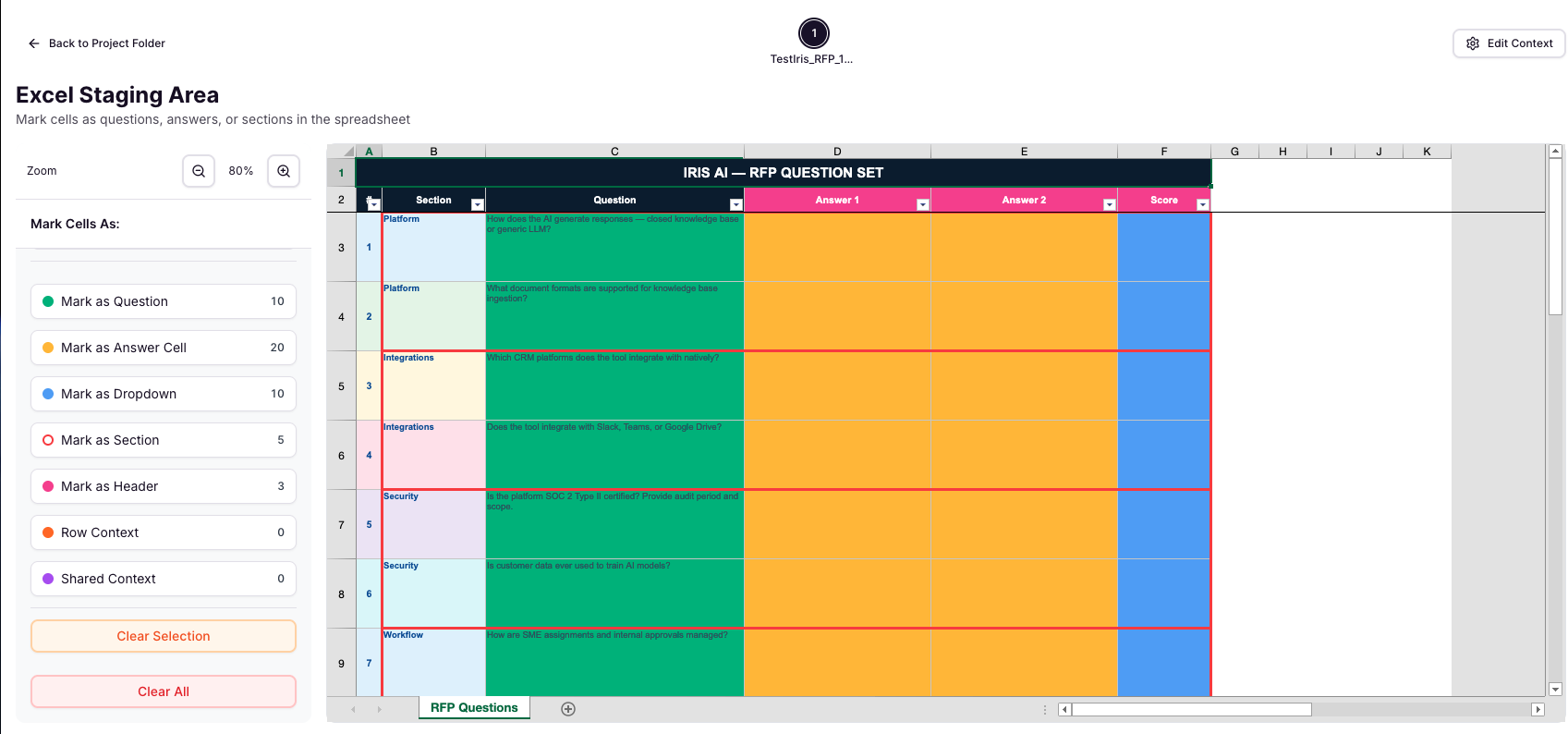
Once your file is uploaded, Iris will open the Excel Staging Area, where you mark which cells are questions, answer cells, dropdowns, sections, and — new with this release — headers.
Auto-Annotation
Click Annotate Current Sheet to have Iris automatically identify and label your spreadsheet structure. Iris will attempt to detect question rows, answer columns, section breaks, and column headers on its own.
The New "Header" Type
The Header annotation type is used to mark the column header rows at the top of your spreadsheet — rows like "Vendor Answers," "Additional Information," "Guidance," and "Analyst Notes." When Iris identifies a row as a header, every answer cell in that column will use it to answer the question.
You can also see detected issues in the Issues panel on the right side of the staging area. These flag orphaned questions or rows that couldn't be automatically classified, so you can resolve them before submitting.
Review and Submit
Once annotation is complete, review the categorized sections listed in the left panel. When satisfied, click Start Processing to submit to Iris.
Step 3: Review Multi-Column Answers in the Project
After Iris processes your file, open the project to review the generated answers. You will immediately notice the new layout for questions that have multiple answer columns.
The Answer Tab Bar
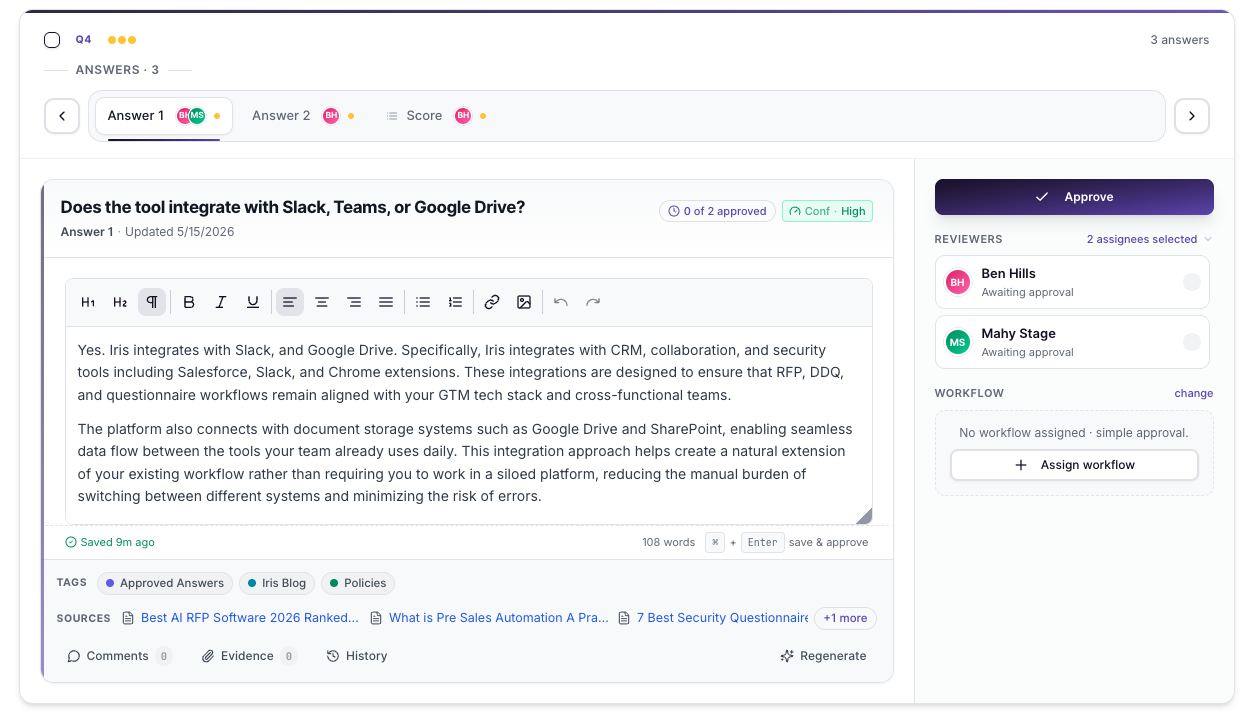
Each question that contains multiple answer columns now displays a tab bar directly beneath the question text. Each tab represents one answer column from your original spreadsheet and is labeled with the column header name (e.g., Answer A, Answer B, Dropdown answer C, Dropdown answer D).
Tabs are lettered (A, B, C, D…) and labeled with the column header name detected during annotation.
Each tab shows a colored indicator dot reflecting the current status of that specific answer.
Use the left and right arrows on either end of the tab bar to scroll through answers if there are more than can be displayed at once.
The "switch" control on the right allows you to toggle the view.
The total number of answers for that question is shown in the top-right corner of the question card (e.g., "4 answers").

Text Answer Columns
Click any text-based answer tab to view and edit Iris's generated response. The answer editor includes the full rich text toolbar and displays:
The column header label (e.g., "Guidance," "Additional Information")
Answer type indicator (e.g., "Rich text")
Last updated timestamp
Confidence level badge (High / Medium / Low)
Approval status badge (Needs Review / Needs Approval / Approved)
Tags, Comments, Evidence, and History actions at the bottom
Dropdown Answer Columns
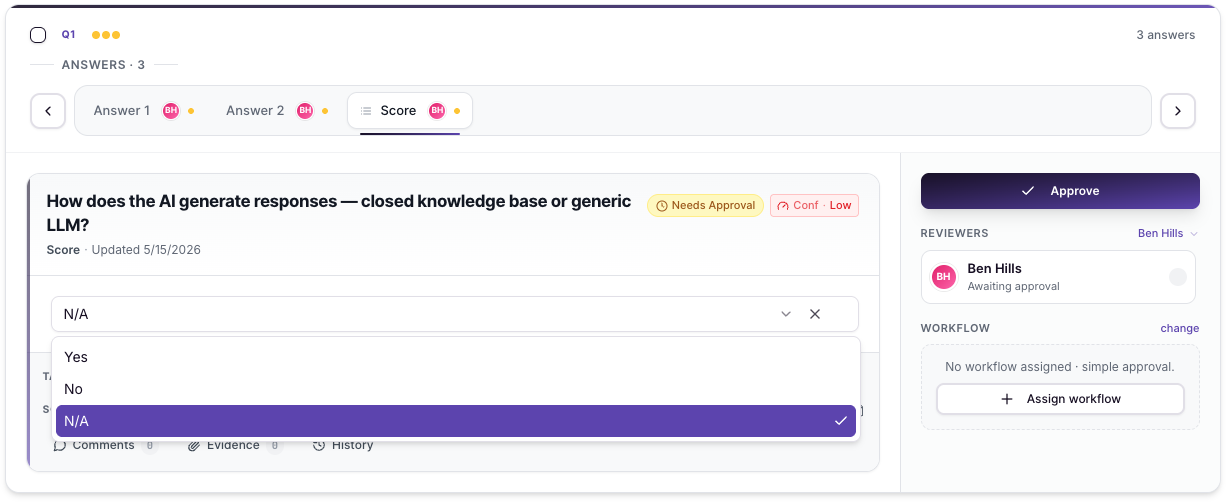
For columns where your original spreadsheet expected a selection from a list (e.g., Yes / No / N/A or predefined options), Iris surfaces these as Dropdown answer tabs. Each dropdown answer displays the available options as a clean, individual selector — not combined with other fields into a single text bar as in the previous version.
Per-Answer Controls (Right Panel)
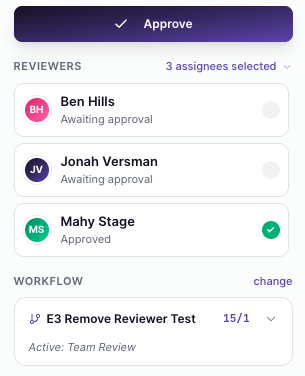
The right panel updates based on which answer tab is currently active. For each individual answer you can:
Approve — Click the blue Approve button to mark that specific answer as approved. Each answer has its own independent approval state.
Undo approval — Approving and un-approving works per answer; changing one does not affect the others.
Reviewers — Assign one or more reviewers specifically to this answer column. Reviewers are tracked per answer, not per question.
Workflow — Assign a workflow (e.g., a 2-step approval flow) to this specific answer. The workflow status and active step are displayed in the panel.
At-a-Glance Status on the Question Card
Without clicking into any individual tab, you can see a summary of how many of a question's answers are approved versus still in review directly from the question card in the project list view. This makes it easy to quickly scan a project and identify which questions still need attention.
Step 4: Focus Mode
Clicking into Focus Mode from any answer opens a detailed, full-screen view for that specific answer. The layout and design language in Focus Mode matches the project detail page, ensuring a consistent experience whether you are working from the list view or drilling into a single answer.
Step 5: Export Your Completed Answers
When you are ready to export, use the Export button as you normally would. Iris will populate all annotated columns in your exported file — not just one. Every text answer, dropdown selection, and additional information field that Iris generated will be written back into the appropriate columns of your spreadsheet.
Assignments Page — Redesigned for Multi-Column Projects
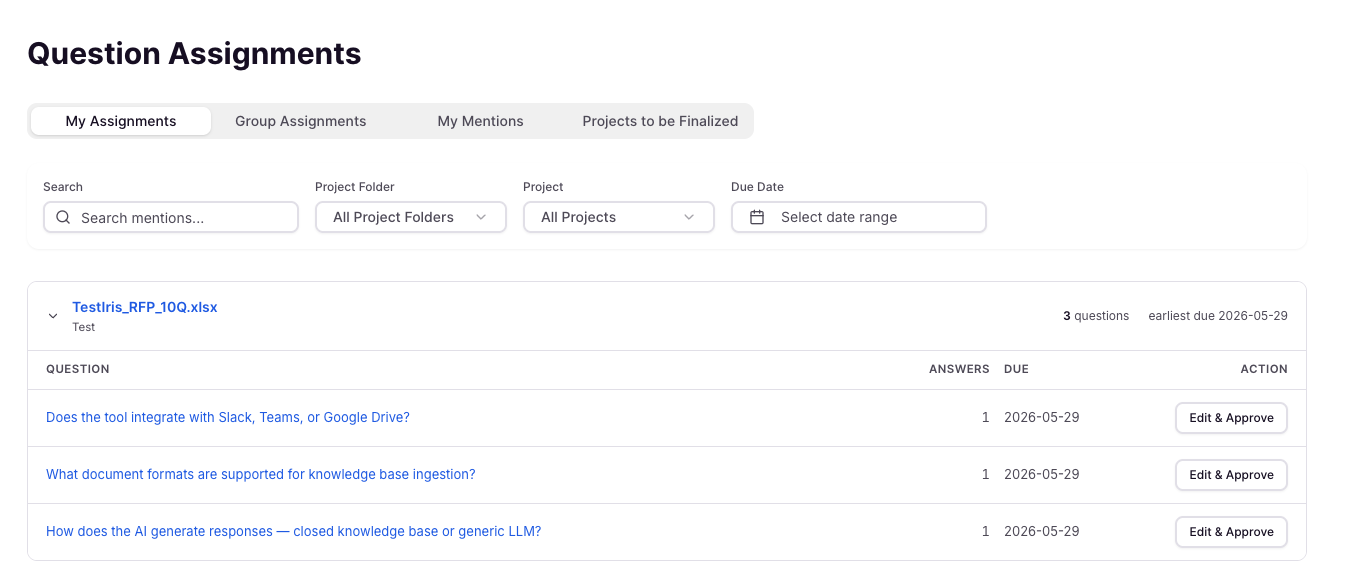
The Assignments page has been significantly updated to support multi-column workflows.
Questions Grouped by Project
Your assigned questions are now grouped by project. Each project group shows:
The project file name and project folder name
The number of questions assigned to you from that project
The earliest due date across those questions
Expand any project group to see the individual questions within it.
Answer Count Per Question
The Answers column in the assignment list now shows how many answer columns you have been assigned within each question. A question with a "2" in the Answers column means you have been assigned two specific answer tabs within that question (not necessarily all answers in it).
Edit & Approve from the Assignment Panel
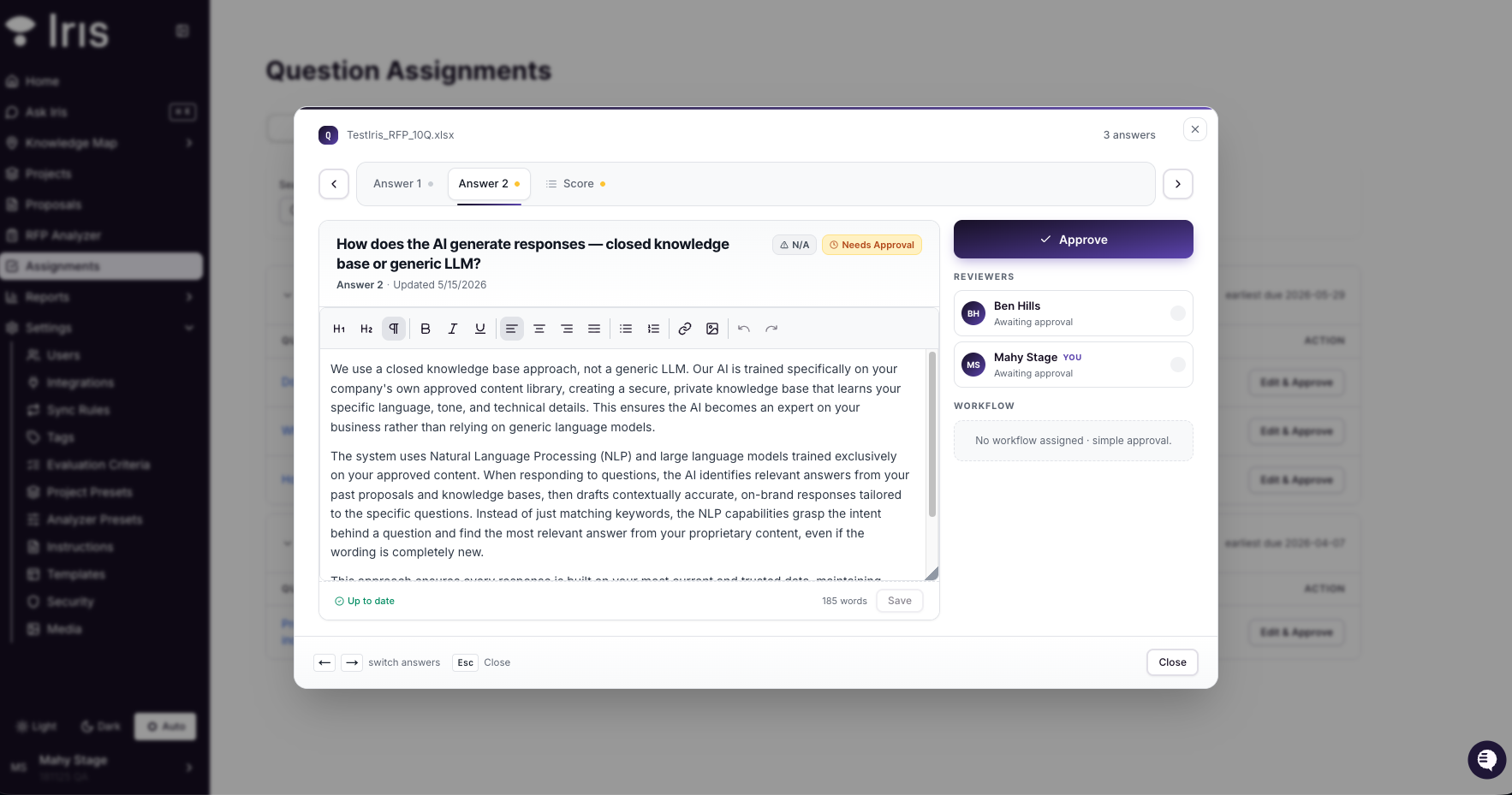
Clicking Edit & Approve on any question from the Assignments page opens a focused panel directly on top of the assignments list. The panel shows:
The project file and folder name at the top
The question text
The answer tab bar, scoped to only the answers assigned to you ("Assigned Answers · 2")
The answer editor, status controls, and reviewer panel for each assigned answer
Arrow navigation to switch between your assigned answers
A Close button or Esc to return to the full list
My Mentions — Deep Linking to Specific Answer Tabs
The My Mentions tab in Assignments now supports deep linking. If you are @mentioned in a comment on a specific answer within a multi-column question, clicking that mention will take you directly to the correct answer tab and automatically open the comment section for that tab — without requiring you to manually navigate to the right column.

Terminology Change: Questions vs. Answers
As part of this update, the focus across the Iris platform has shifted from the question level to the answer level. A question is now treated as a container or section, and all status tracking, approval workflows, assignments, and lifecycle management happen at the individual answer level. Filters throughout the platform (status, assignee, confidence) now operate on answers, not questions.
This means when you filter a project by "Needs Review," you are filtering to show questions that contain at least one answer in that state — and the relevant answer tabs will be highlighted accordingly.
Frequently Asked Questions
Does each answer column have its own approval history?
Yes. Each answer has its own modification history, approval log, and comment thread. Changes to one answer column do not affect the history of another column in the same question.
Can I assign different workflows to different answer columns in the same question? Yes. Each answer tab supports its own workflow assignment. You can have a simple approval on one column and a multi-step review workflow on another column within the same question.
Can I assign different reviewers per answer column?
Yes. Reviewers are assigned at the individual answer level. Different team members can be responsible for different columns within the same question.
What happens if a column header isn't detected automatically during annotation?
You can manually mark any row as a Header using the "Mark as Header" option in the left panel of the Staging Area. We recommend reviewing the auto-annotation results before submitting to ensure headers are correctly identified.
What answer types are supported for multi-column?
Both text answers (rich text) and dropdown answers are fully supported. Each answer column is independently typed based on how it was annotated in the Staging Area.
Does export work the same way?
Yes — the export process is unchanged. Iris writes all generated answers back into the appropriate columns of your original spreadsheet file.